Niklaus Riggenbach (1817–1899), born in Alsace to Swiss parents, patented his rack-and-pinion system for mountain railways in France in 1863 — a ladder rack of steel plates connected by round rods, set centrally between the running rails, interlocking with a cogwheel under the locomotive. He had been working independently from Sylvester Marsh in the United States, who had patented a similar system in 1861 and whose Mount Washington Cog Railway opened to fare-paying passengers in 1868. The Vitznau-Rigi Bahn, built by Riggenbach together with engineers Ferdinand Adolf Naeff and Olivier Zschokke, became the first mountain rack railway in continental Europe when it opened on 21 May 1871 — Riggenbach’s 54th birthday, a date he had arranged deliberately. The first trial run had taken place exactly one year earlier on the same date, on a 300-metre test section at Vitznau. Construction had begun in September 1869 and the line covered 5 kilometres, climbing 1,115 metres at a maximum gradient of 25 percent. It was extended to the summit at Rigi Kulm (1,752 m) on 27 June 1873.
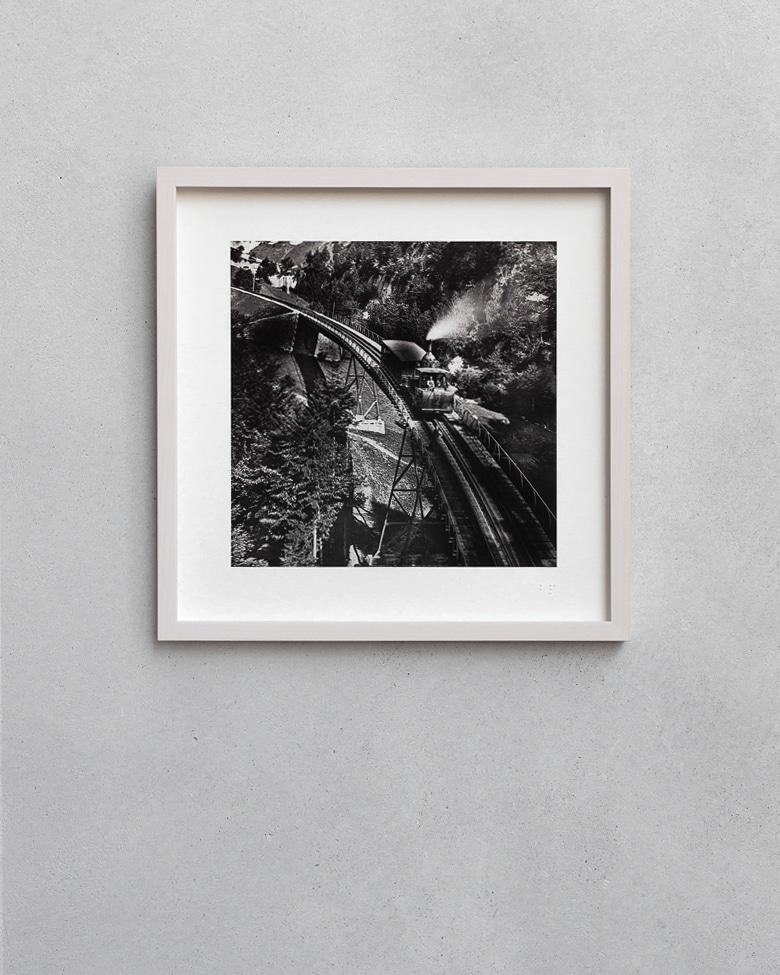
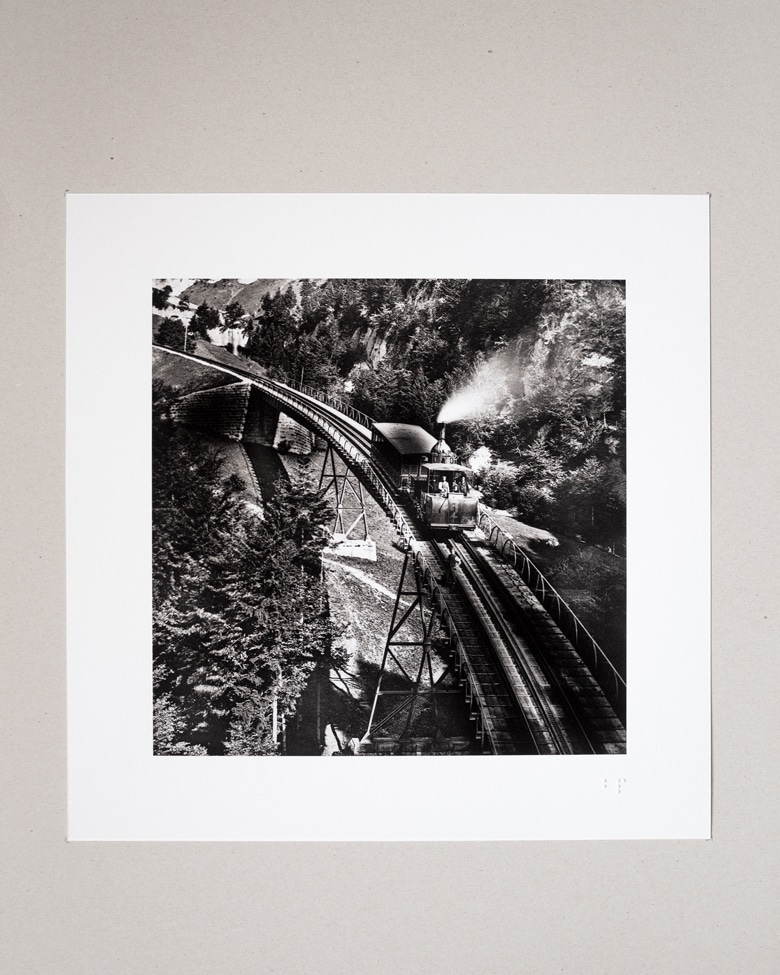
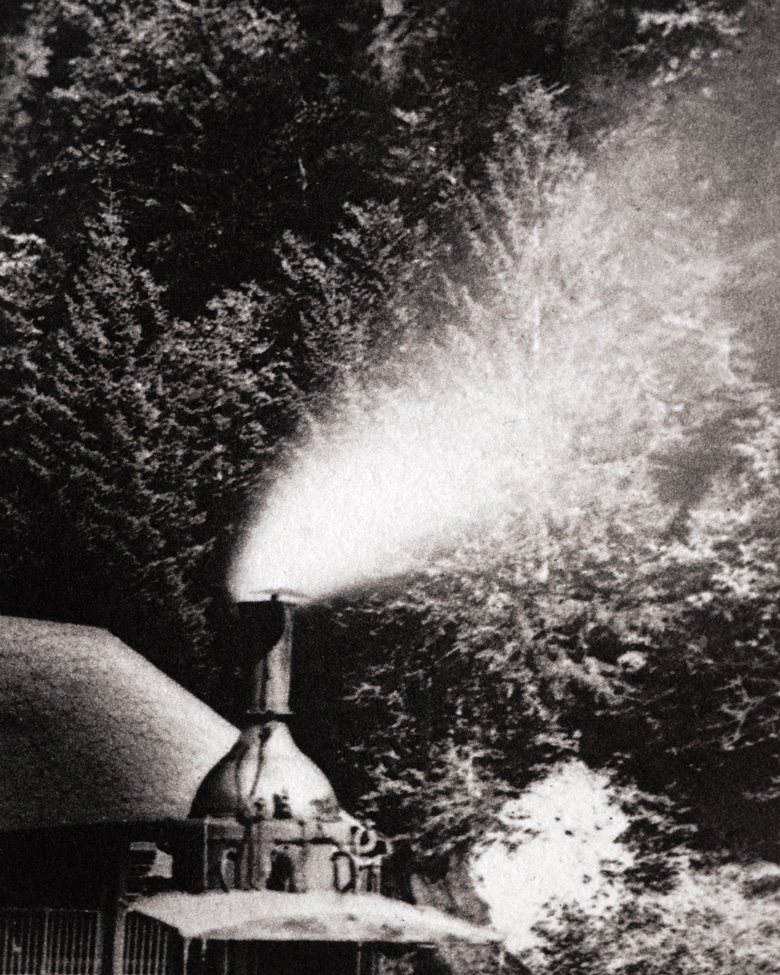
The vertical boiler visible in this photograph is the defining visual characteristic of the line’s early steam locomotives. The design was not arbitrary: on gradients of up to 25 percent, a conventional horizontal boiler would cause the water level to shift, exposing the crown sheet at one end and risking catastrophic failure. A vertical boiler maintains a constant water level regardless of inclination. The original locomotive, No. 1 Stadt Luzern, built in 1871, remains the only surviving standard-gauge rack-fitted vertical-boilered locomotive in the world. The locomotive numbered 2 in this photograph is one of the early series built to the same design. The rack rail between the running rails — Riggenbach’s ladder rack — is clearly legible in the foreground of the image.
The image is taken from above, looking down onto a trestle section of the line. Two crew members stand on the footplate; the locomotive faces the camera. The composition is characteristic of stereoview production for the tourist market: the trestle structure occupies the left half of the frame as a demonstration of the engineering, while the locomotive and its crew provide human scale and foreground interest. By c. 1880, the Vitznau-Rigi line had been in operation for nearly a decade and was carrying several hundred thousand passengers per year, having established the template for alpine rack railways across Switzerland and beyond.
The plate
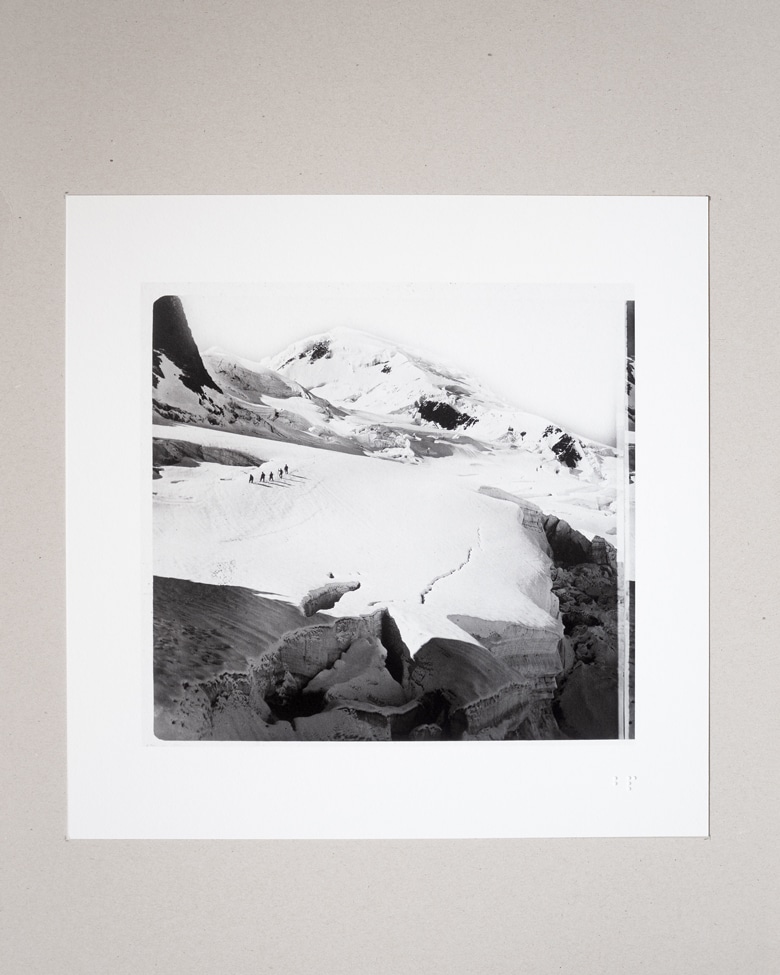
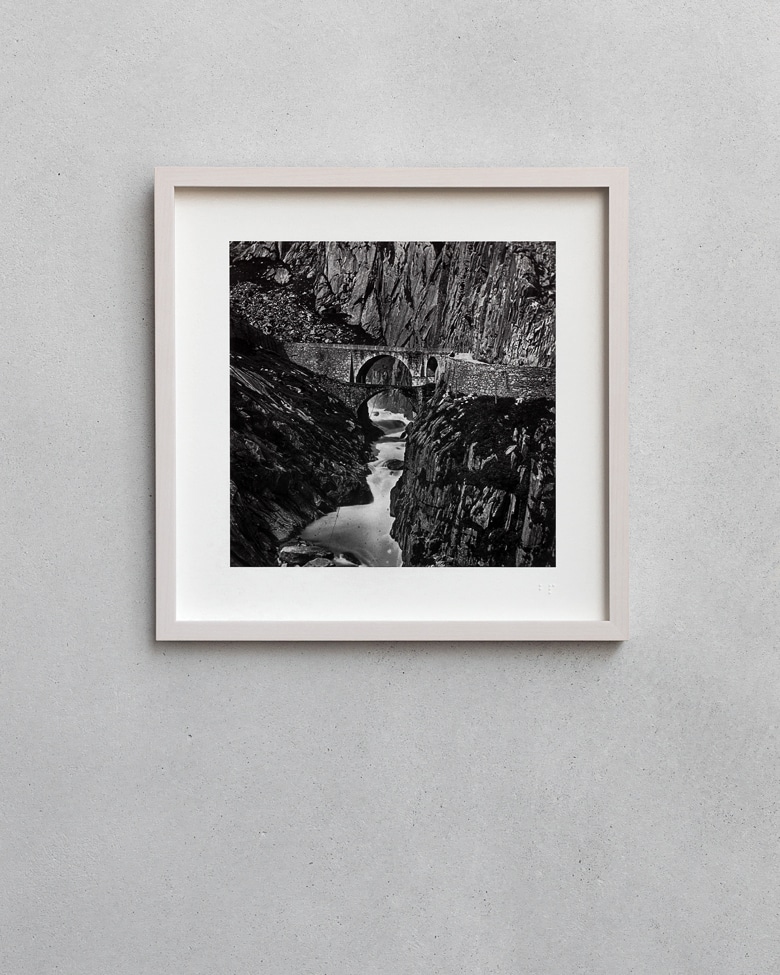
Stereoscopic glass slide, anonymous photographer. Dated c. 1880. From the blackprint collection. Piezography® Pro print on Arches Velin BFK Rives White, 250 g/m² — a 100% cotton paper made by cylinder mould at the Moulin d’Arches in the Vosges (founded 1492), sole production site of the BFK Rives since 1982, when production was transferred from the Isère mills, a tradition rooted in Rives since 1573, carrying the ∞ watermark of archival permanence. Edition of 365, Zürich.