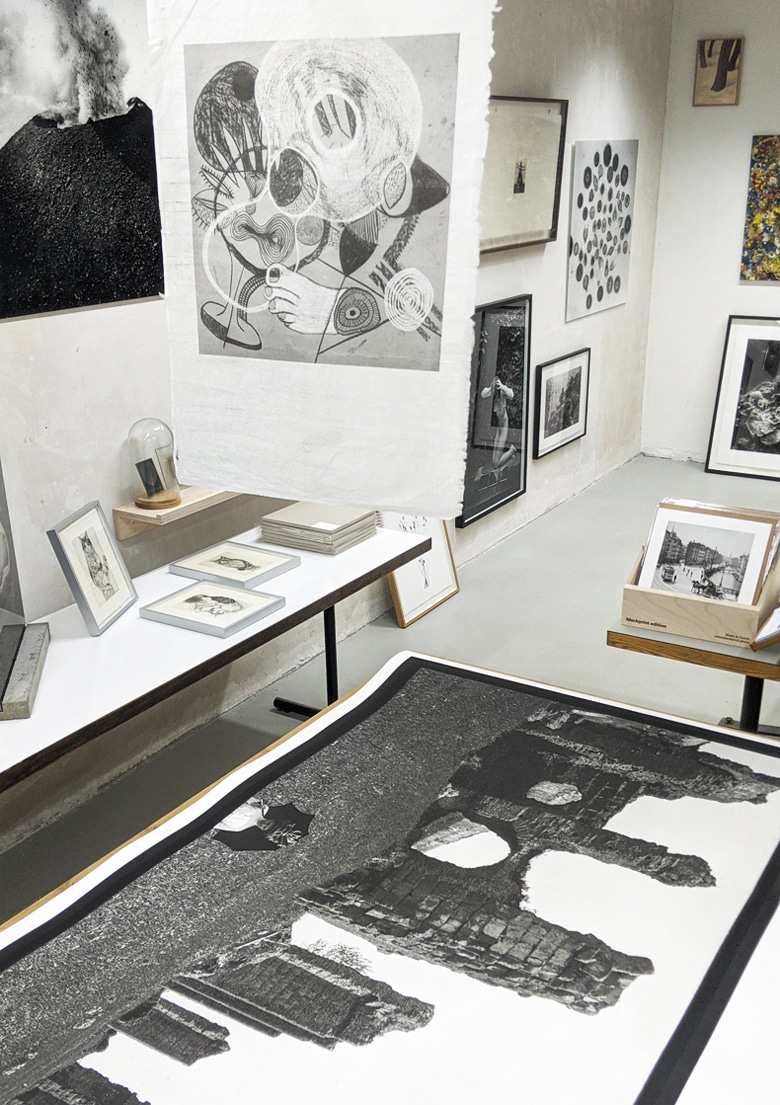
The blackprint studio — Piezography® Pro Fine Art Printing
Working with blackprint is a collaborative process. From the choice of paper to tonal calibration and finishing, every decision is taken in dialogue with the artist or photographer — because each of these decisions shapes the final object. We develop custom linearization curves for every paper we use, including papers developed outside the inkjet printing tradition.
Piezography® Pro Black-and-White Printing
blackprint’s practice is rooted in carbon pigment inks — no color dyes are involved at any stage. Tonal richness is achieved through the blending of two distinct ink sets, warm and cool.
This system produces a range of tonal combinations from subtle split-toning to a precisely calibrated neutral print, with the warm-to-cool axis controllable across the full tonal range or independently in shadows and highlights.
For matte surfaces, Ultra HD Matte Black ink delivers one of the highest dMax levels achievable in inkjet printing. This depth, combined with fine resolution, produces continuous tonal modulation and a density in shadows that few processes can approach.
For glossy and baryta papers, a Gloss Optimizer is applied simultaneously with the pigments — a micro co-polymer that coats each carbon particle, eliminating gloss differential and bronzing, and ensuring a uniform surface regardless of viewing angle.
Because carbon is elemental and chemically stable, these prints are designed to remain unchanged for years.
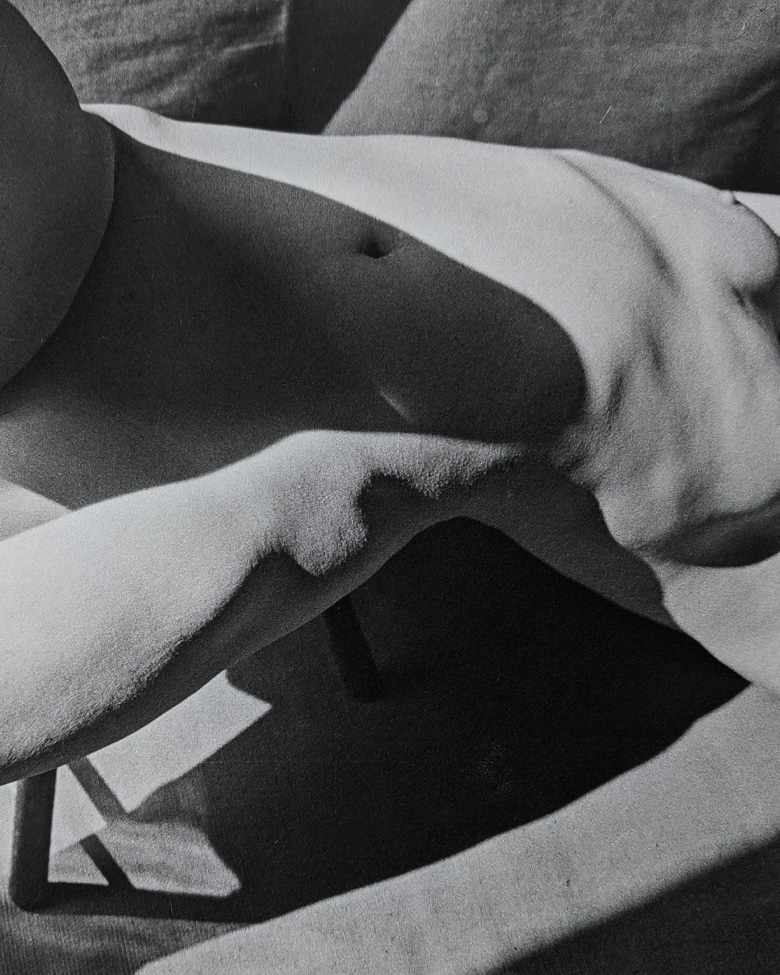
Detail of Piezography® Pro print on handmade Japanese paper.
© blackprint edition – Karo collectors
Fine Art Papers for Black-and-White Photography
The choice of paper is not a finishing decision — it is part of the creative process. At blackprint, each paper is selected for two distinct but inseparable qualities: its archival integrity, and its character. The weight of a sheet, the colour of its white, the transparency of its fibres, the way a surface absorbs or resists ink — each of these properties will either support an image or enter into tension with it. This relationship between substrate and photograph is central to how we work.
Our paper collection spans a wide range, from one of the world’s thinnest papers at 2 g/m² to heavyweight handmade sheets reaching 400 g/m². It is continuously evolving, shaped by ongoing research and direct collaboration with papermakers. We actively source papers produced by master craftsmen, including works by Japanese Living National Treasures (国宝 – Kokuhō) — papers available only in limited batches, and whose particular qualities cannot be replicated.
The selection includes artisanal Japanese Washi, Swiss Cartalafranca, historical Arches BFK Rives, Awagami Inkjet papers, and surfaces from established manufacturers such as Canson, Hahnemühle, Innova, and Moab. Many of these papers were developed outside the inkjet printing tradition and require custom linearization curves built specifically for each substrate.
Photographers and artists are welcome to bring their own papers for evaluation — each project is an opportunity to find the precise balance between technical requirements and artistic intent.
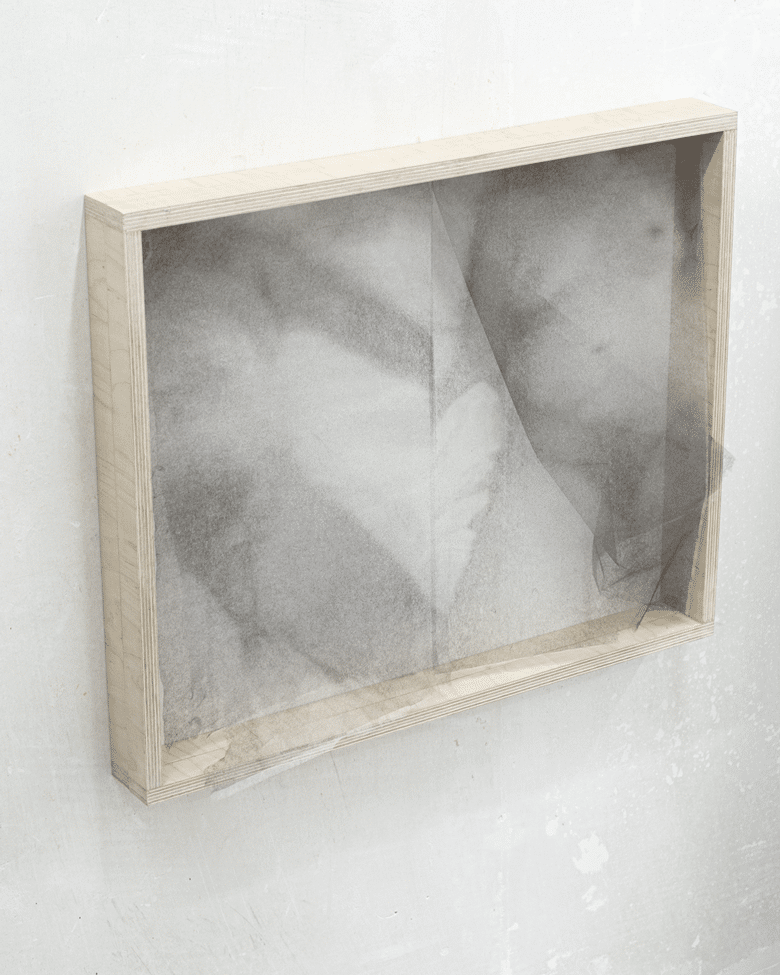
Piezography® Pro on the thinnest paper in the world (1.6 – 2 g/m2)
© blackprint edition – wonow
Laminated Glass Objects for Photographic Prints
For selected projects, prints are transformed into sculptural objects through a laminated glass process. The choice of glass depends on the paper and the work: museum glass — ultra-clear and anti-reflective — is used where surface interference would compromise the reading of tonal subtleties and shadow detail. For very thin papers, such as handmade sheets at 20 g/m², extra-clear glass without anti-reflective treatment is sufficient, and preserves the particular transparency of the substrate.
The print is thermally bonded between two glass panes of 2mm each with a dedicated interlayer, under vacuum for more than ten hours. This process integrates UV protection directly into the object — no additional coating or framing required. At just 4mm total thickness, the result is a monolithic, self-sufficient object with diamond-polished edges, displayable freestanding or wall-mounted, where the image, the material, and the light interact directly.
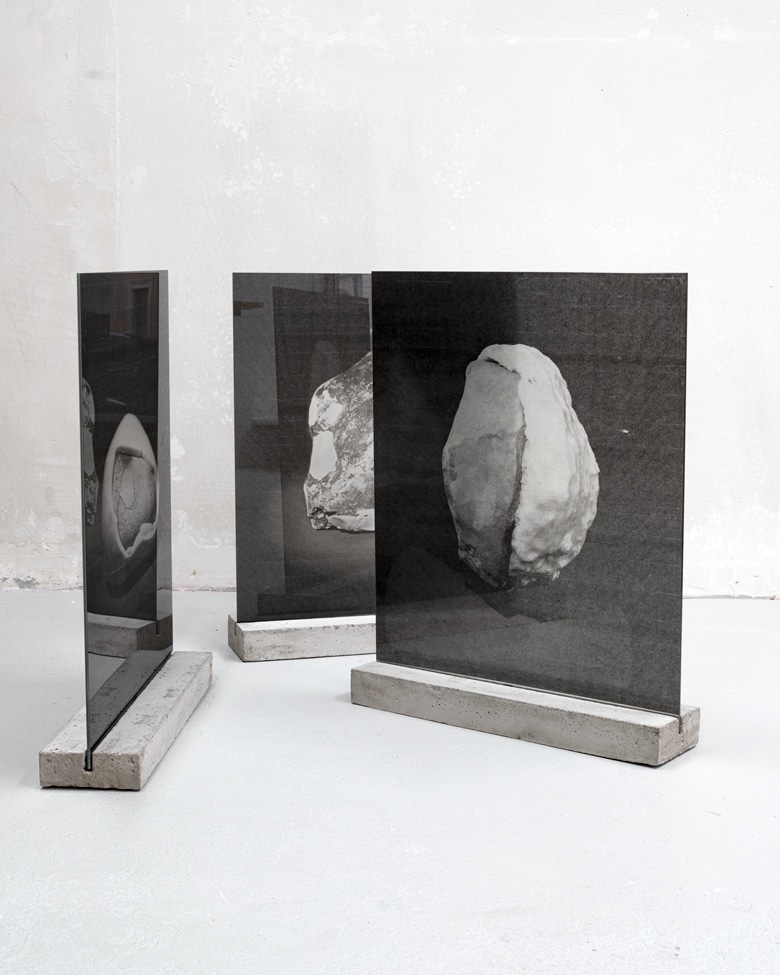
Handmade Himalayan paper (20 g/m²) printed with Piezography® Pro, vacuum-sealed between 2mm mineral glass.
© blackprint edition – Diego Brambilla
Work with us
The essential qualities of a blackprint print — the texture of a handmade paper, the depth of carbon blacks, the presence of a laminated glass object — cannot be fully understood from a screen. We encourage a visit to the studio to explore our paper collection and view editions firsthand.
To discuss a project, request a quote, or send files for a test print, contact us directly. For technical specifications on file preparation, please refer to our FAQ.