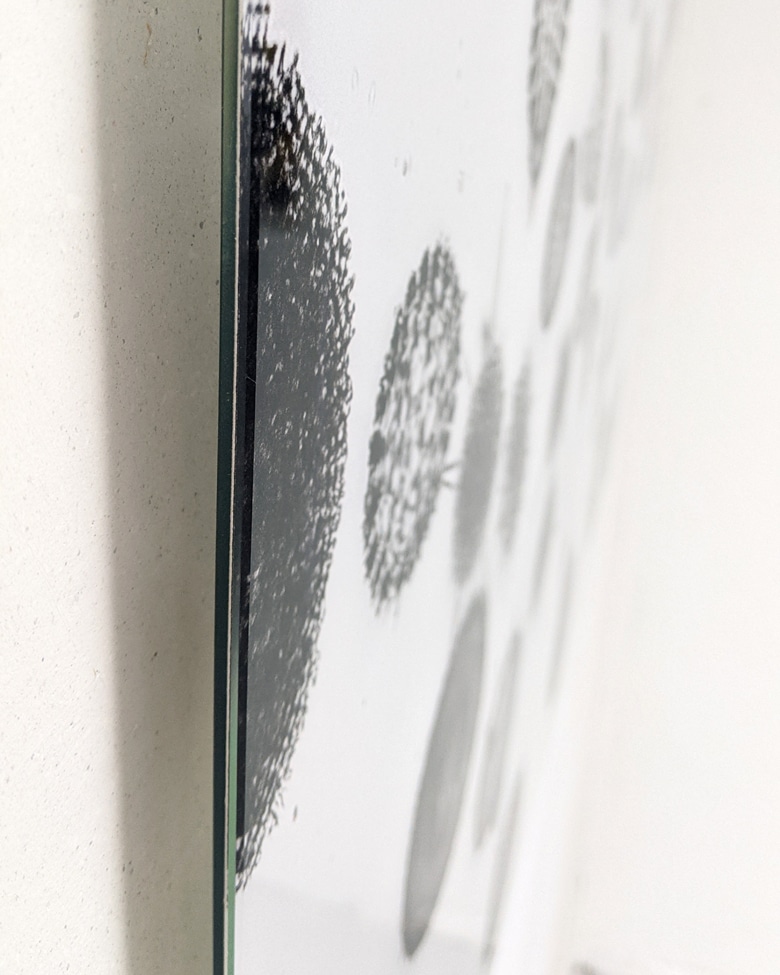
Polycystina | Ed. of 15

CHF 5'800.00

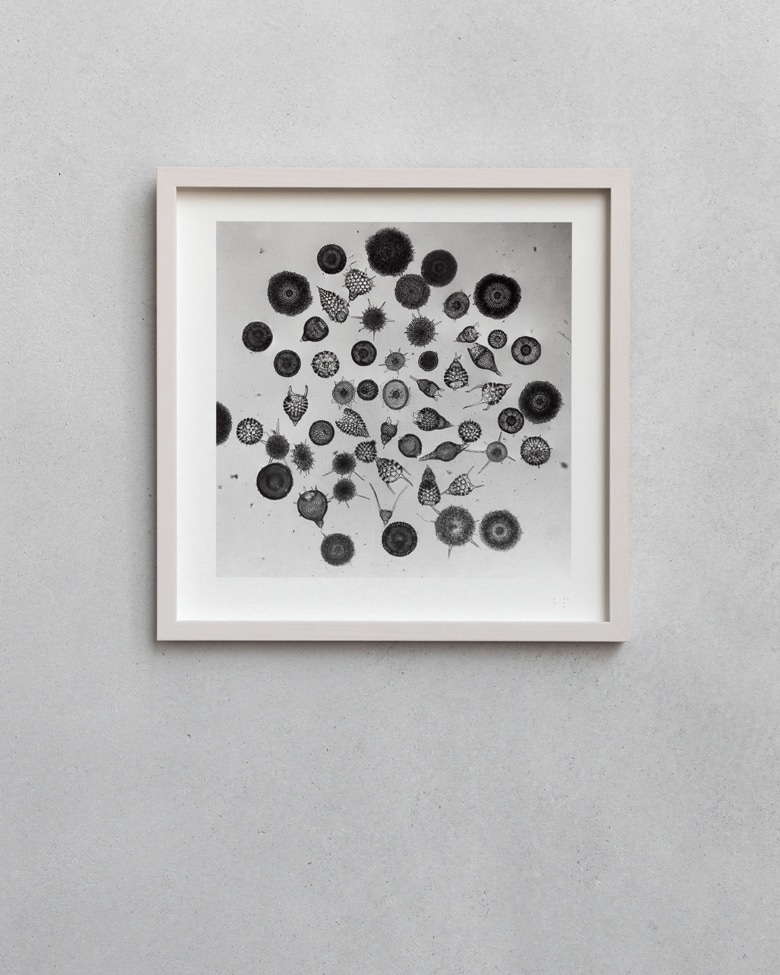
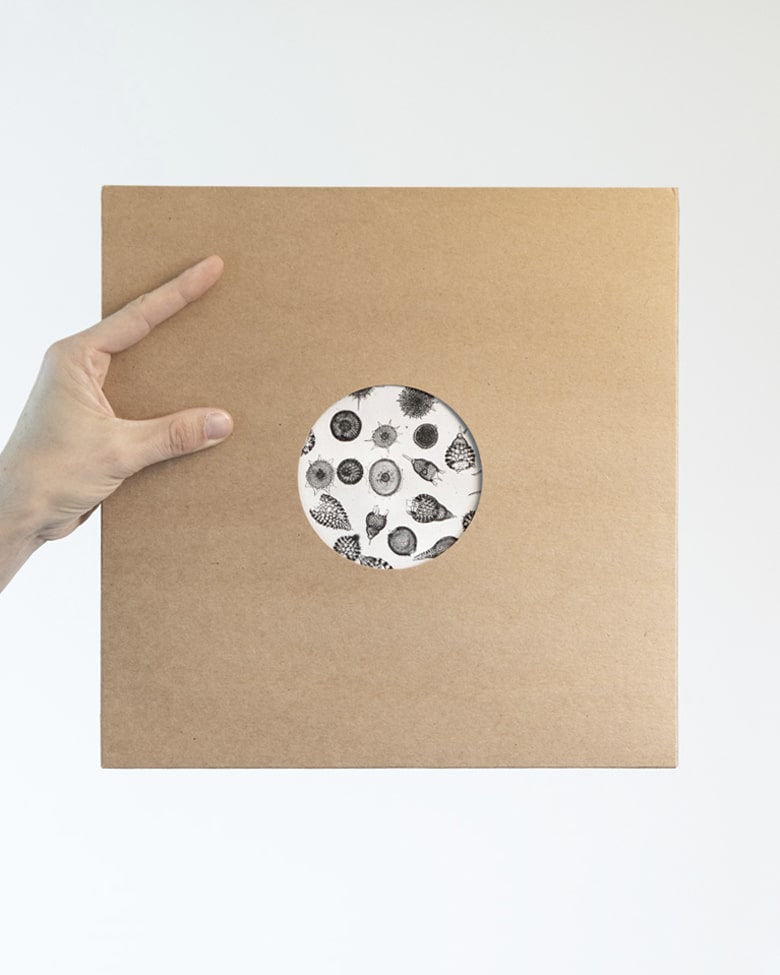
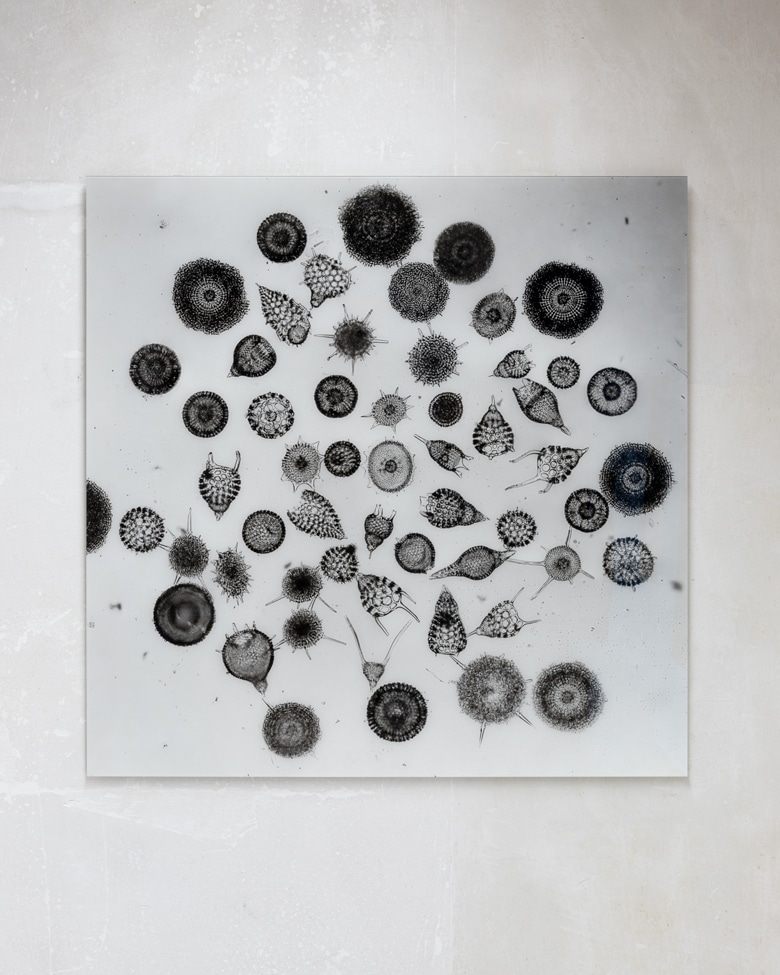
Title: “Polycystina from Barbados”
Year: 1890
Country: England
Photographer: Richard Suter
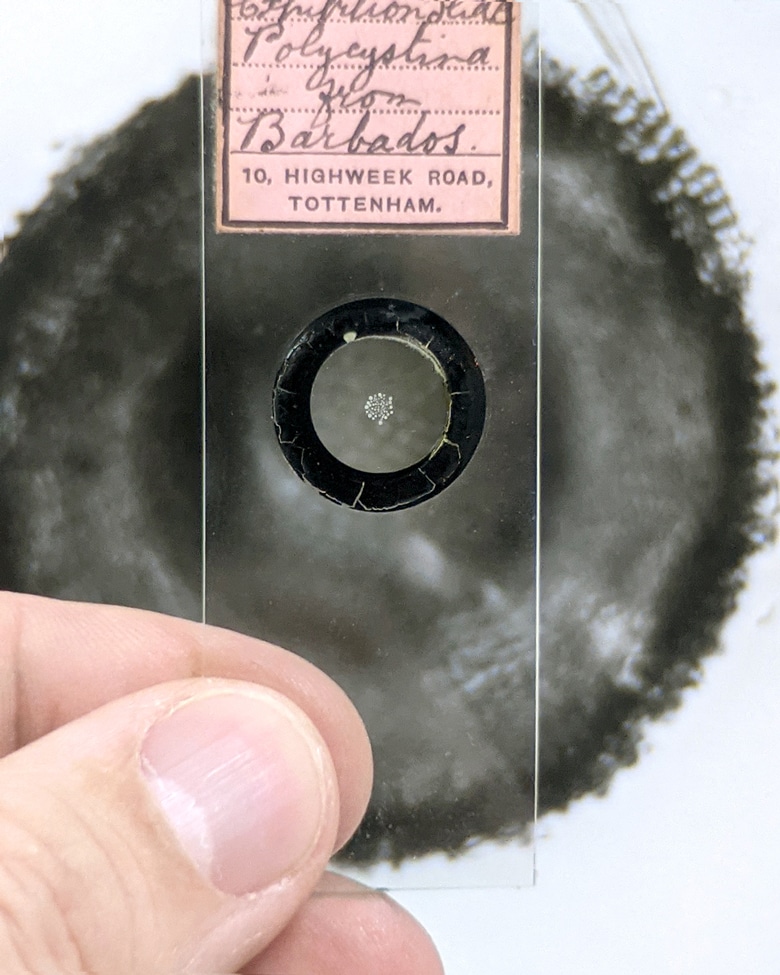
Origin: Microscope slide 2.6 × 7.5 cm / The blackprint collection

Size Glass & Print: 89.5 × 89.5 cm | 89.5 × 89.5 cm
Printing technique: Piezography® Pro
Paper: A.I.J.P Awagami Bamboo 170 gr/m2. pH-neutral.
Laminated Glass: Front: HY-TECH-GLASS, 2 mm non-reflective extra-clear. | Back: Glass, 2 mm float.
Weight: 8 Kg

Edition of 15, Zürich
blackprint with Abgraphics Studio

Provided with a Verisart blockchain Certificate of Authenticity.
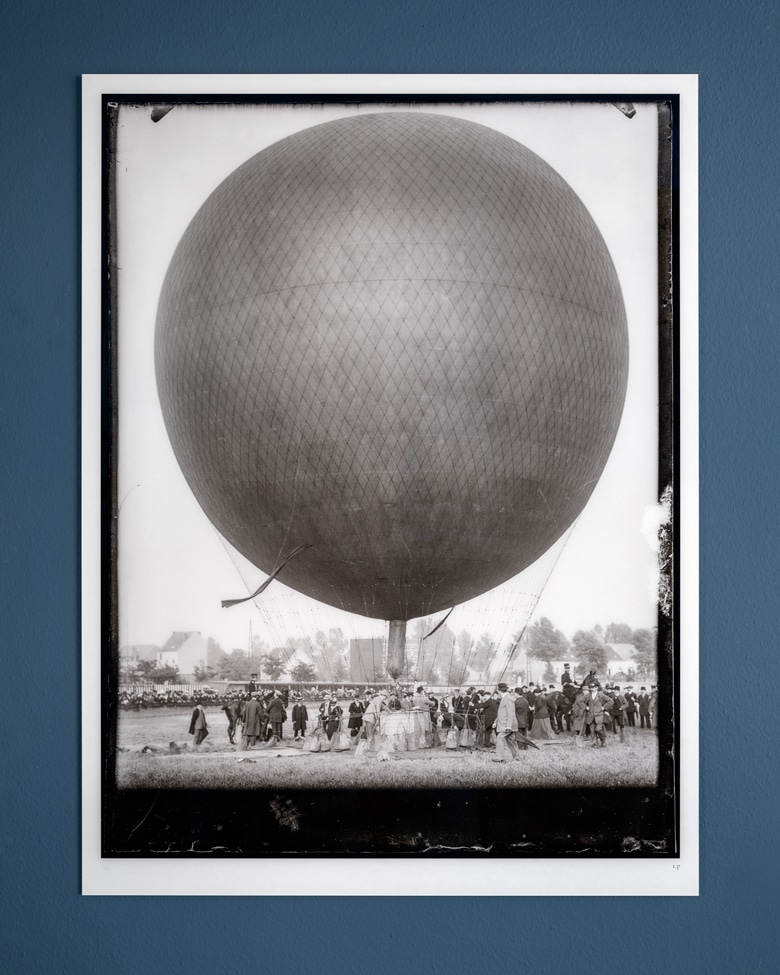
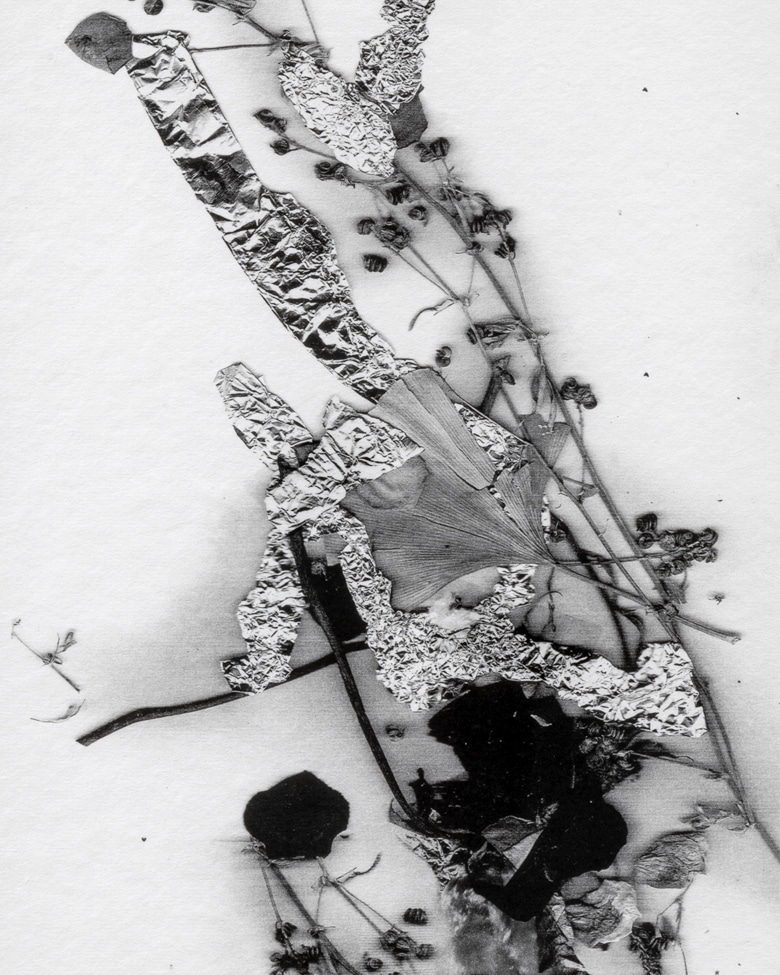
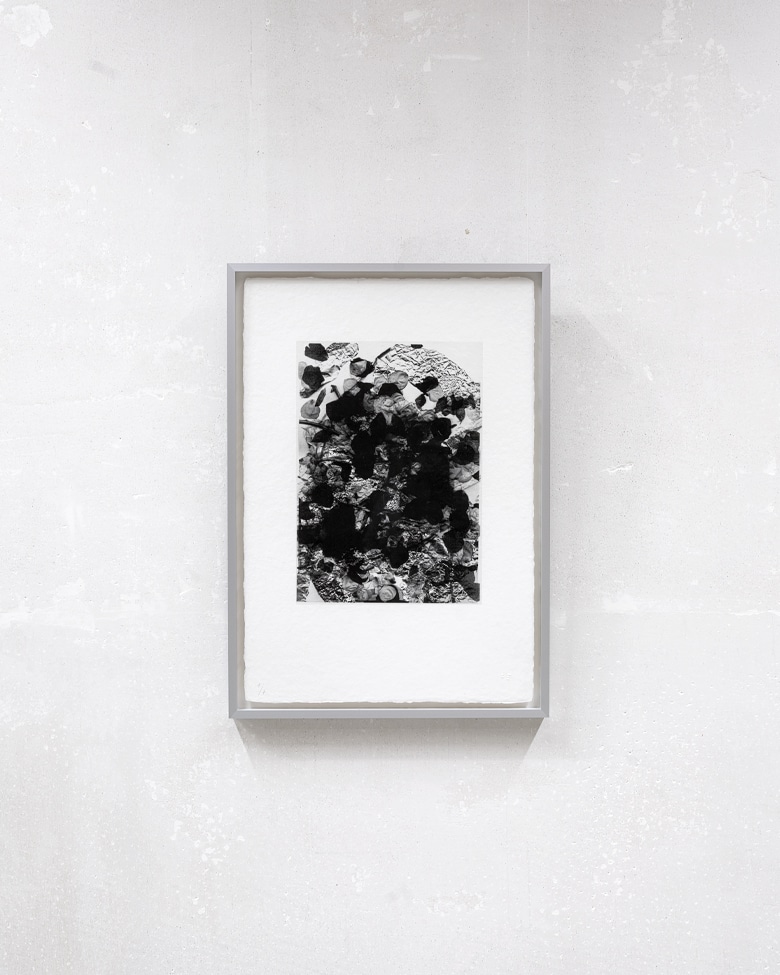
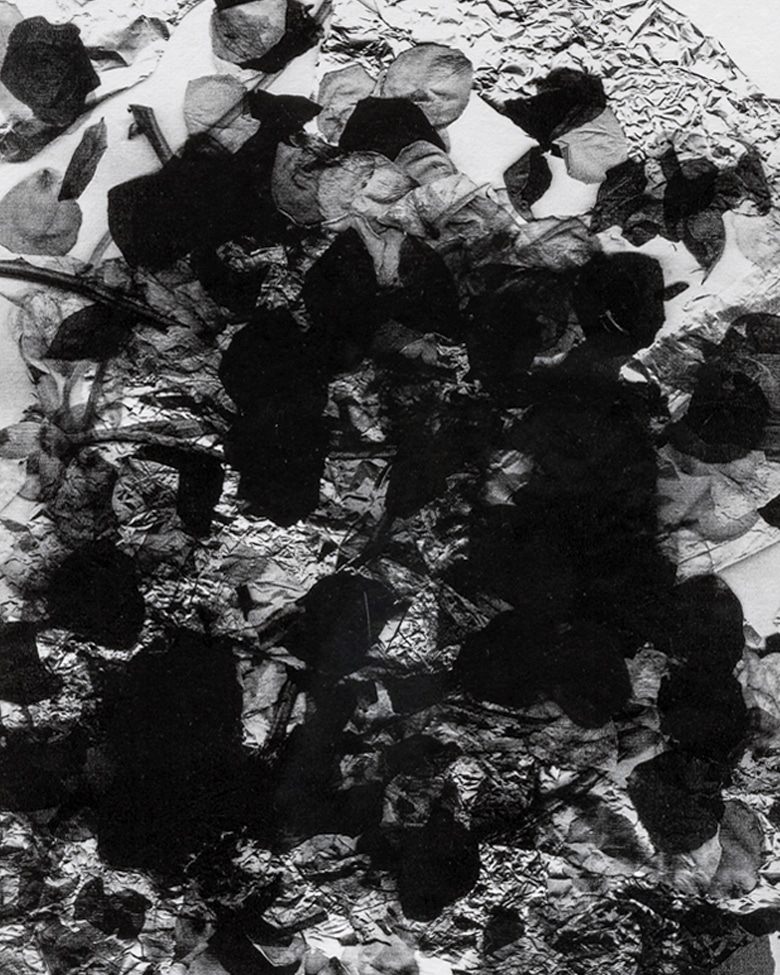
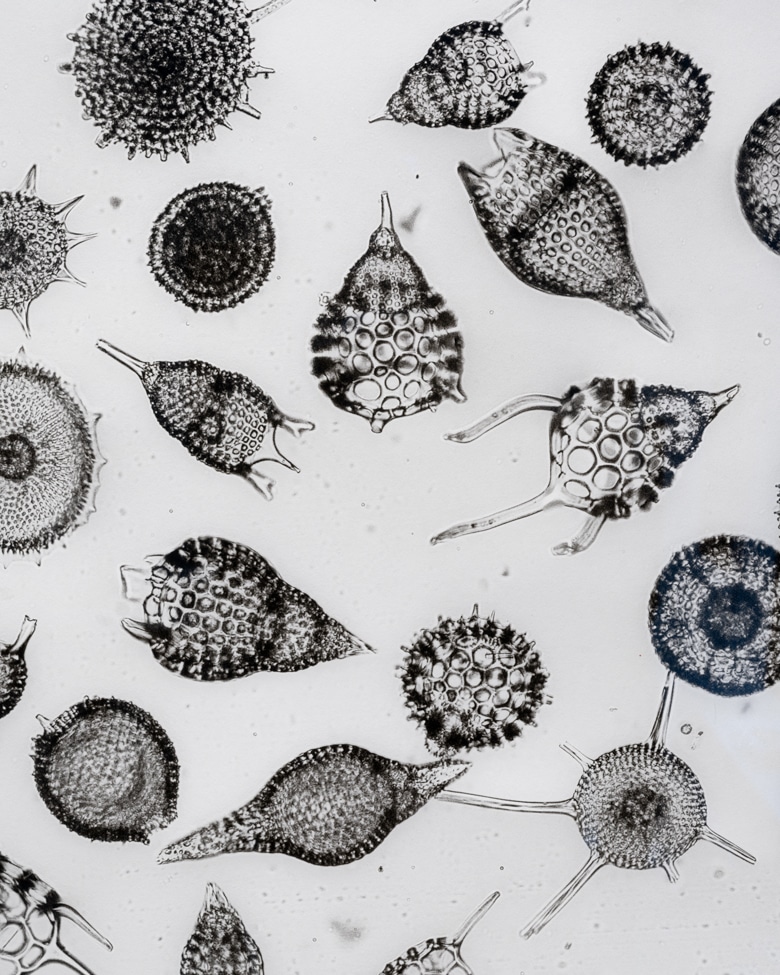
Approximately fifty radiolarian skeletons — Polycystina from Barbados, arranged on a microscope slide by Richard Suter of Tottenham ca. 1893 — reconstructed from approximately one hundred separate exposures and printed at 89.5 × 89.5 cm on Awagami Bamboo Washi, laminated between two panes of mineral glass. The original grouping measured 2mm.

The full history of this plate in About the artwork.

About the artwork

Richard Suter
Richard Suter trained as a school teacher before beginning to prepare and sell microscope slides in the late 1880s, running his enterprise from the family home on Highweek Road, Tottenham. By 1892, his advertisements announced “50,000 choicest microscopic slides of every description in stock.” His slides are identified by their distinctive pink or salmon labels, hand-lettered in his characteristic script. The label on the blackprint slide reads: “Exhibition Slide. Polycystina from Barbados. Richard Suter, 10 Highweek Road, Tottenham.” An exhibition slide was a higher-order preparation — arranged for visual impact as much as for scientific study, intended to demonstrate the maker’s skill at its best.

The Polycystina of Barbados
Polycystina are radiolarians: single-celled marine organisms that secrete intricate silica skeletons — spherical, latticed, spiked — of a complexity that bears no relation to their scale. Individual skeletons range from roughly 50 to 500 micrometres. In 1846, the physician John Davy discovered a substantial deposit of polycystine skeletal remains in a sedimentary layer on the Caribbean island of Barbados, and brought samples back to England. The deposit is Eocene in origin — the remains of organisms that lived between approximately 35 and 45 million years ago, accumulated on an ancient ocean floor and later lifted to the surface through the tectonic processes that formed the island. The material circulated rapidly among microscopists, who found that the Barbados earth — treated with acid to dissolve the surrounding carbonate — yielded slides of exceptional diversity and clarity. Suter’s preparations were among the most sought-after objects in the Victorian slide trade. What he arranged on his slide are not fossils in the conventional sense: not mineral casts that replaced an original structure, but the original silica skeletons produced by the organisms themselves, stable enough to survive intact for tens of millions of years. The objects in the print are the objects that were alive.

The object
The original grouping of polycystine skeletons on Suter’s slide measures 2mm across. Printed at 89.5 × 89.5 cm, the enlargement factor is approximately 450×. At this scale, the largest forms reach several tens of centimetres across, and the latticed architecture of each skeleton, its spines, its surface texture, its relationship to the skeletons around it, becomes fully legible as structure. The reconstruction process that made this possible — approximately one hundred exposures at successive focal planes, combined into a single composite image — is what the object makes visible: not a single instant of microscopic observation, but the full spatial volume of Suter’s arrangement, rendered at a scale no optical instrument could have produced in a single pass. The print on Awagami Bamboo Washi is thermally bonded between two panes of 2mm mineral glass — extra-clear and non-reflective on the front, float glass on the back — under vacuum for more than ten hours. At 4mm total thickness, the object requires no frame: image, paper, and glass form a single self-sufficient whole, its edges diamond-polished, displayable freestanding or wall-mounted.

The plate
Microscope slide, 2.6 × 7.5 cm, blackprint collection. Prepared by Richard Suter, 10 Highweek Road, Tottenham, England. Label: “Exhibition Slide. Polycystina from Barbados.” Printed on Awagami Bamboo Washi, 170 g/m², 89.5 × 89.5 cm. Laminated glass object, edition of 15, Zürich. Accompanied by a Verisart Certificate of Authenticity registered on the blockchain.

Additional information
Weight 8000 g
Dimensions 90 × 0.5 × 90 cm
Fixing for wall mounting

with wall bracket, without wall bracket

Size

Shipping information

Switzerland
Free shipping for all blackprint editions.
Orders are typically shipped within 2 to 3 days when the edition is in stock.

Worldwide
Free delivery for unframed artworks.
Shipping periods may vary depending on the destination country.

Please note that this limited edition will be shipped from Zürich, Switzerland, and may be subject to any relevant duties and taxes imposed by the destination country.

Our returns policy is applicable for 14 days after order is received.
For more information, refer to our ‘Sales Conditions‘.

Secure Payment information

We accept credit card (VISA, Mastercard) and payment with Paypal, Apple Pay, Google Pay and Twint (+”Pay later” option, purchase now and pay in 30 days).

Payment with Postfinance is also available, along with the ‘click&collect’ option for picking up your edition at the blackprint studio in Zurich.

Additionally, we accept cryptocurrency payments using Crypto.com Pay, Nowpayments or other Ethereum/ERC-20 compatible wallets.

Feel free to contact us for any questions at edition(at)blackprint(dot)photo

You may also like…